
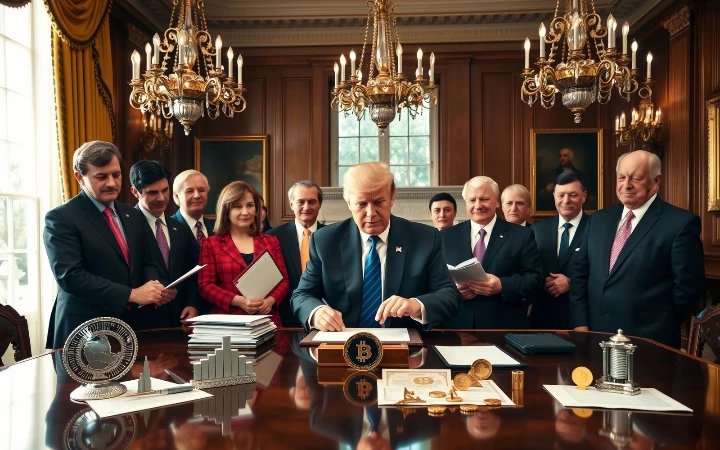
An executive order signed by President Trump on Thursday instructed the Securities and Exchange Commission (SEC) to promote the use of alternative assets in the 401 (k) scheme and other retirement accounts. This initiative marked a major shift in the area of retirement investment, opening traditionally conservative industries to more speculative and sometimes less liquid investments. Typically, most 401(k) participants are offered a range of equity or bond funds or index products as investment options.
The White House wrote in a statement: “President Trump hopes to give United States workers more investment options to achieve stronger and more economically secure retirement outcomes. More than 90 million Americans participate in employer-sponsored fixed-contribution schemes, most of whom are currently restricted from investing in alternative assets, while pension schemes for wealthy investors and government workers are not.
“other types of assets, such as private equity, real estate and digital assets, provide competitive returns and the benefits of diversification.”
This move was supported by large asset management companies, including Belet and KKR, which would open up a trillion-sized retirement account industry to more diversified funds managed by those companies. “Personal assets such as real estate and infrastructure can increase returns and protect investors during periods of market downturns.” In his latest annual investor letter, Bélédé President Larry Fink wrote, “We need to be clear: private assets are legal in retirement accounts. They are useful and increasingly transparent.”
In addition, on 18 July, President Trump signed the Genius Act, which is designed to regulate the use of this type of encrypted currency, the stabilization currency. This legislation was introduced after the “encrypted currency week” in Congress, when both houses were committed to passing the Clarity Bill, the GENIUS Bill and the Anti-CBDC Bill.
Among them, the Clarity Act seeks to define the regulatory oversight of encrypted currency, while the Anti-CBDC Surveillance Status Act seeks to prevent the Federal Reserve from establishing a central bank digital currency. Both bills have been passed in the House of Representatives and are awaiting a Senate vote.