
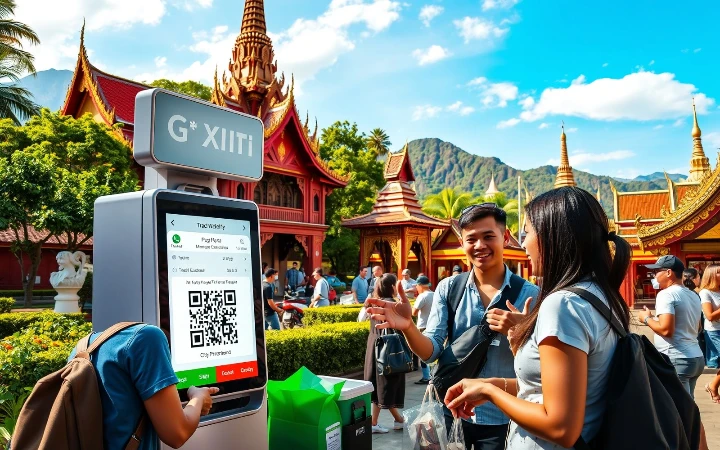
The Securities and Exchange Commission of Thailand (SEC), together with the Ministry of Finance, the Anti-Money Laundering Office (AMLO) and the Ministry of Sports and Tourism, jointly announced on 18 August the launch of Tourist Digipay, an 18-month sandbox project to allow foreign tourists to convert digital currency into Thai baht for local consumption. The initiative aims to enable foreign tourists to use digital currency as a source of finance for consumption in Thailand, while promoting the application of innovation and digital currency to support economic and tourism development.
The pilot project, which is expected to commence in the fourth quarter of 2025, aims to integrate the digital currency trading system, to be supervised by the SEC, with the electronic money framework, to be supervised by the Bank of Thailand (BOT). The project allows the digital currency exchange, dealers and brokers authorized by the SEC to cooperate with the electronic money service provider regulated by BOT. Visitors need to complete their knowledge of your client (KYC) and to open an electronic wallet upon arrival. They can then transfer and sell digital currency, receive baht to electronic wallets and consume it through a system based on a two-dimensional code. The consumption limits are as follows: for small retailers up to 50,000 baht per month, and for businesses certified through the KYM procedure up to 500,000 baht per month (approximately US$ 15,384).
The bulletin also states: “In the case of `Tourist Number Payment' sandboxes, foreign tourists can make payments through scanning (e.g. via smartphone applications) in various businesses across Thailand, including large retailers and small vendors. Importantly, digital currency does not allow direct payment for goods and services, and the merchant will receive payment for the baht.”
Ms. Pornanong Budsaratragoon, Secretary-General of the Securities and Exchange Commission of Thailand, stressed the consistency of the project's legislation: “The `Tournal Digital Payment' project is based on the existing ecosystem, which integrates the digital money-trading system regulated by the SEC and the electronic currency system regulated by the Bank of Thailand.” She noted that the system included a KYC and customer due diligence (CDD) process based on AMLO standards. Proponents of digital currency argue that such a framework would help to legitimize the use of encrypted currency while stimulating tourism and economic activity and providing a model for prudent adoption in a regulated environment.