
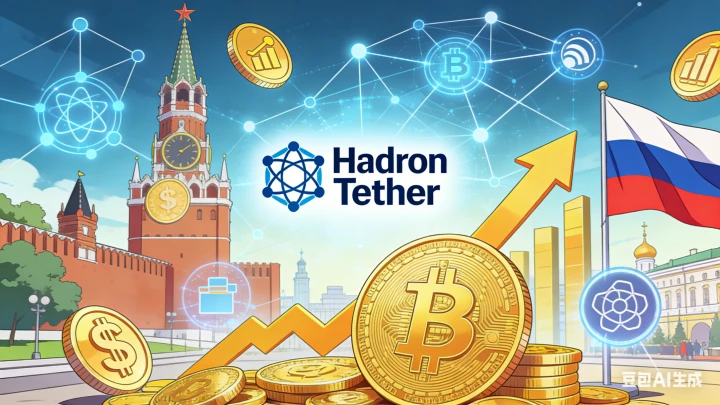
Tether, as the issuer of the USDT stabilization currency, has been approved by the Russian Patent Office (Rospatent) for its trademark on the Hadron monetization platform. According to Russian media RIA Novosti, on 10 January, Tether submitted an application to Rospatent in October 2025, which was reviewed and approved by the Agency at the end of last year.
Expansion of markets and exclusive rights
This approval means that Tether now owns exclusive use of the trademark in Russia until 3 October 2035. According to Rospatent's bulletin, the trademark covers block-chain financial services, encrypted currency transactions and exchange, encrypted related financial advice, encrypted payment processing and related consulting services.
The Hadron platform, launched in November 2024, aims to enable enterprises to publish divided shares, bonds, incentive credits, corporate equity and commodities in the form of digital tokens on a block chain network.
Past challenges and future prospects
Nevertheless, Tether's history in Russia has not been easy. Less than a year ago, Tether frozen USDT worth $28 million on the Russian encrypted currency exchange Garantex, which appears to respond to a request from the United States Secret Service. Garantex stated at the time that Tether “had joined the war on the Russian encrypted market”.
However, as the Central Bank of Russia updated its rules on encrypted transactions in its cross-border trade sandbox to allow Russian enterprises to use encrypted currency as a payment tool for international partners, Tether obtained a trademark approval this time indicating his intention to further expand Russia ' s rapidly growing encryption and private block-link market.
The rise of tokenism
Currently, monetization is already a multi-billion-dollar industry in Russia. According to Central Bank data, the Russian token industry, supported by private block chains alone, is worth approximately $13 billion. Numerous institutions, including banks, metal companies and stock exchanges, have issued coins linked to precious metals, real estate and large commodities such as cocoa beans.