
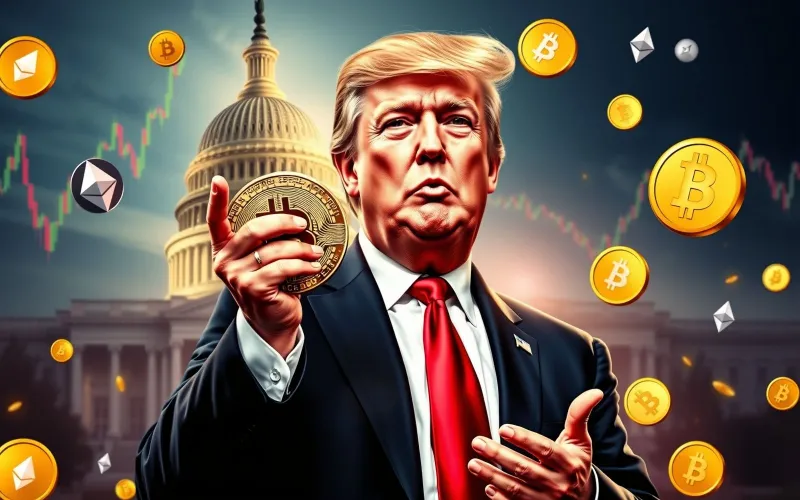
During the presidential campaign of 2024, Donald Trump promised to become the “encrypted currency president”. However, since he began his second term in January, the value of encrypted currency has fallen significantly. The price of bitcoin fell from over $100,000 on the date of entry to $81,000 at the time of writing. It is noteworthy that there has also been a decline in the financial market as a whole, with the Standard & Poor ' s 500 index falling by about 12 per cent since Trump took office.
Nevertheless, current sales may provide an opportunity for encrypted money investors, especially those interested in bitcoin. This is because the policy adopted by Trump may eventually be more favourable than the TT, which is the largest and most widely used encrypted currency, with two recent policies supporting, in particular, Bitcoin ' s next buffalo.
Strategic encrypted currency reserves
On 3 March, Trump announced that the United States would set up strategic and encrypted currency reserves, including bitcoin, the YCP, XRP, Solana and Cardano. The reserve was designed to make the United States the “encrypted capital of the world”. It only holds assets confiscated as a result of criminal or civil proceedings and does not buy or sell any encrypted currency on the market. Those investors who wanted the United States to become a big buyer were disappointed.
However, this encrypted currency reserve can play an important role in the next round of cattle markets in Bitcoin and other encrypted assets. In fact, it recognizes these assets as legitimate assets with a storeable value, which paves the way for more institutional investors to adopt bitcoin. With the approval of the United States Government, such assets now look far less risky. Over the next few years, growing institutional adoption will be the biggest driver of bitcoin value.
2. Effects of the Trump tariff
There is an important relationship between the dollar and the value of bitcoin. When the dollar weakens, investors look for alternative assets, such as encrypted currency. In theory, import tariffs should increase the relative value of the dollar. However, large tariffs imposed by Trump have had the opposite effect. Since the announcement of extensive tariffs on 2 April, the United States dollar index has declined by about 1.8 per cent at the time of writing. If tariff announcements dating back to January were issued against Canada and Mexico, the index would have declined by about 5.5 per cent.
Investors are aware that under these tariff policies, the United States is less attractive to enterprises than before. The profitability and productivity of United States companies will be under great pressure and growth will be more difficult. The dollar will weaken further as investors withdraw from the United States market. At the same time, the support of the Government for the use of bitcoin and other encrypted currencies as a reserve asset has also laid the foundation for another round of bitcoin cattle.