
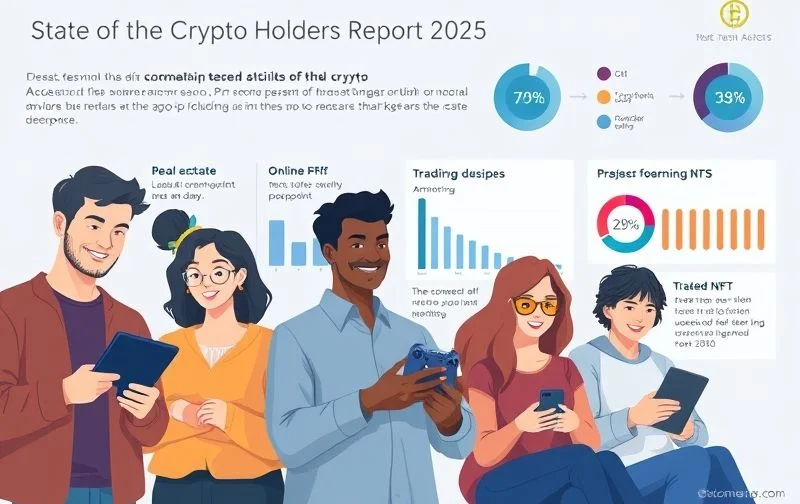
The Chief Legal Officer of Ripple, Stuart Alderotey, is now President of the newly established National Association of Encrypted Currency (NCA) and has published a large-scale survey of United States encrypted currency holders. NCA is a not-for-profit organization funded by Ripple, which focuses on encrypted money education.
Data are alarming: 21 per cent of adults in the United States — about 55 million people — currently hold digital assets.
According to the Report on the Status of Encrypted Currency Holders 2025, published in cooperation with the Harris poll, encrypted money has become deeply rooted in American daily life.
Nearly 76 per cent of users mentioned the positive impact of encrypted currency on their lives, and about 49 per cent listed increased financial independence as one of the greatest benefits.
The study challenges some of the common assumptions about the population using encrypted currency. For example, 12 per cent of encrypted currency holders work in the construction industry, while only 7 per cent work in financial services.
Although most platform users are younger — 67 per cent of whom are under 45 — reports indicate that 15 per cent are older than 55. Interestingly, about 31% of users are women, which means that encrypted money is no longer just a "brother" game.
“The data tell us that people from a variety of backgrounds are involved in encrypted money in many ways, and that they not only look forward to the future, but have benefited from it today.” Stuart Alderotey says that he played a key role in the historic Ripple-SEC legal battle.
Users report multiple uses of encrypted money, which research shows is not just set aside as an investment; it is also used in everyday life. Nearly 40 per cent of users spend their encrypted currency, while 9 per cent use it daily. Participants also noted that they traded NFTs and digital collections. A significant number of people reported using encrypted money to participate in decentivized online games. It is noteworthy that encrypted currency is also used to complete real estate transactions.
The study also showed strong confidence in digital assets. Seventy-six per cent of the holders expressed greater confidence in encrypted currency and non-traditional banks. Sixty-four per cent supported government regulation in this area, while 67 per cent feared that overregulation could hinder innovation.
Research shows that 73 per cent believe that the United States should strive to be a global leader in encrypted monetary development and policy.